Comentarios
Básicos
Los comentarios son líneas de instrucciones inactivas. Estas líneas no son interpretadas por el programa 4D y no se ejecutan cuando el código se llama. Specific features rely on comments for documenting and tagging your code.
Hay dos maneras de crear comentarios:
//para crear una línea de comentario/* ... */for inline or multiline comments.
Ambos estilos de comentarios pueden utilizarse simultáneamente.
Comentarios de una línea (//comentario)
Inserte // al principio de una línea o después de una instrucción para añadir una línea de comentario. Ejemplo:
//Este es un comentario
For($vCounter;1;100) //Bucle inicial
  //comentario
  //comentario
  //comentario
End for
Comentarios en línea o multilínea (/*comment*/)
Rodea el contenido con los caracteres /* ... */ para para crear bloques de comentarios en línea o multilíneas. Tanto los bloques de comentarios en línea como los multilínea comienzan con /* y terminan con */.
- Las líneas de comentarios en línea se pueden insertar en cualquier parte del código. Ejemplo:
For /* inline comment */ ($vCounter;1;100)
	...
End for
- Multiline comment blocks allow commenting an unlimited number of lines. Los bloques de comentarios pueden anidarse (útil desde que el editor de código 4D soporta los bloques contraídos). Ejemplo:
For ($vCounter;1;100)
/*
comentarios
    /*
    otros comentarios
    */
*/
Comments for syntax description
Comments can describe the syntax of your methods, class functions, or constructors.
- For a method, write the comment block in the first lines of the method. In the 4D code editor, comments are displayed in its Help tips (the 5 first lines are displayed).
- For a class function or constructor, write the comment block immediately above the
FunctionorClass constructordeclaration. Comments are displayed with the signature in 4D code assistance and in VS Code (completion details, help tips, and signature help). Add a dedicated comment for every parameter with the// $paramName: <text>syntax (see below).
Ejemplo:
// Adds or updates a local dependency (as a file URL) in the "dependencies" object of the environment file
// $folder: folder of the dependency to register
// $optionalName: optional dependency name (defaults to the folder's full name)
#DECLARE($folder : 4D.Folder; $optionalName : Text)

//...code
The comment block follows these rules:
- It is made of
//lines and/or a/* */block. Each line of a/* */block is handled like a//line, and the/*and*/markers are not displayed. - For a class function or constructor, it must be placed immediately above the declaration. A blank line between the comment block and the declaration breaks the association: only the signature is displayed.
- Each comment block is associated only with the next declaration, even when it is written right after the code of the previous function.
- Only the saved code is read: after you edit a comment, the code assistance shows the new text once the class is saved.
- The text is displayed as plain text: Markdown markers such as
**or*are shown as written.
Ejemplo 1
You want to document a function and its parameter so that they are displayed in the code editor:
// Class: Invoice

// Returns the price with taxes
// The rate is a percentage
// $rate: tax rate to apply (20 for 20%)
Function priceWithTaxes($rate : Real) : Real
	return This.price*(1+($rate/100))
When you type $invoice.priceWithTaxes( in a method, the help displays the signature with:
Returns the price with taxes
The rate is a percentage

$rate: tax rate to apply (20 for 20%)
Ejemplo 2
You want to document a class constructor with a /* */ block:
// Class: Counter
property value : Integer
property name : Text

/*
Creates a counter starting at a value
$start: initial value of the counter
{$name}: name of the counter
*/
Class constructor($start : Integer; $name : Text)
	This.value:=$start
	This.name:=$name || "default name"
You can display:
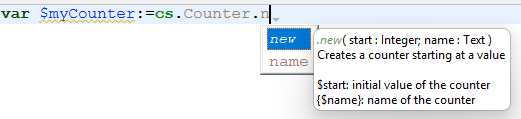
Comments for specific features
MCP tool
When a function is published as an MCP tool, its comments are used to provide MCP tool code description, including MCP behavior tags.
Code navigation markers
Code navigation markers such as MARK:, TODO:, and FIXME: are inserted through comments. See Manual tagging.